
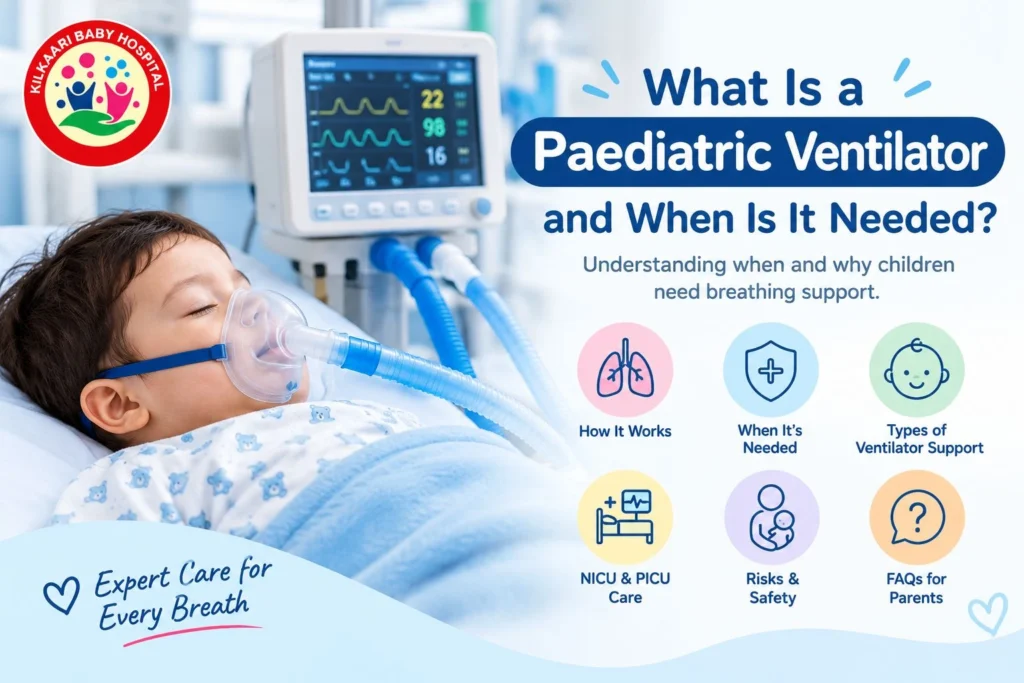
A child’s breathing is essential for delivering oxygen to the body and removing carbon dioxide. However, some children may develop serious breathing difficulties due to infections, premature birth, lung conditions, injuries or other medical problems. In such situations, doctors may recommend breathing support using a paediatric ventilator.
A paediatric ventilator is a medical device that helps a baby or child breathe when they cannot breathe adequately on their own. Depending on the child’s condition, it may provide additional breathing assistance or temporarily take over much of the work of breathing. For parents, hearing that their child needs a ventilator can be frightening. Understanding how a ventilator works, when doctors use it and what happens during treatment can help families feel better informed.
This guide explains paediatric ventilator support, common reasons for its use, the role of the Neonatal Intensive Care Unit (NICU) and Paediatric Intensive Care Unit (PICU), and when to seek emergency medical care.
What Is a Paediatric Ventilator?
A paediatric ventilator is a machine that supports breathing in infants and children who need help moving air into and out of their lungs.
It can help deliver oxygen, support the movement of air and help remove carbon dioxide from the body. The exact type of support depends on the child’s age, size, diagnosis and severity of illness. A ventilator does not directly cure the underlying disease. Instead, it supports breathing while doctors treat the condition responsible for the problem.
Paediatric ventilators are used in hospitals, including intensive care units, where trained healthcare professionals can closely monitor the child’s breathing, oxygen levels and response to treatment.
How Does a Paediatric Ventilator Work?
A paediatric ventilator provides breathing support through a carefully selected method. The medical team adjusts its settings according to the child’s condition and monitors how effectively the lungs are functioning.
The process may involve the following steps:
- Assessment: Doctors assess the child’s breathing, oxygen levels, medical history and overall condition.
- Selection of breathing support: The team decides whether the child needs oxygen, non-invasive ventilation or invasive mechanical ventilation.
- Delivery of breathing support: Depending on the method, support may be delivered through a mask or through a breathing tube placed into the windpipe.
- Continuous monitoring: Healthcare professionals monitor oxygen levels, heart rate, breathing pattern and other clinical measurements.
- Adjustment of treatment: Ventilator settings are changed as needed according to the child’s response.
- Gradual reduction of support: When the underlying condition improves, the medical team assesses whether the child can breathe safely with less assistance.
The type and amount of support required vary from one child to another.
When Is a Paediatric Ventilator Needed?
Doctors may recommend ventilator support when a child’s breathing is inadequate or when the child cannot maintain safe oxygen or carbon dioxide levels without assistance.
Common situations include:
Severe Respiratory Distress
Respiratory distress occurs when a child has difficulty breathing or must work unusually hard to breathe. Possible signs include rapid breathing, grunting, flaring nostrils and the skin pulling inward around the ribs or chest.
Mild cases may improve with appropriate treatment and oxygen support. More severe cases may require ventilation if the child cannot maintain adequate breathing.
Severe Pneumonia
Pneumonia is an infection that affects the lungs. In severe cases, inflammation and fluid in the air sacs can make it difficult for oxygen to pass into the bloodstream.
Some children may need oxygen therapy or other respiratory support. A ventilator may be necessary when breathing failure develops or less intensive support is insufficient.
Respiratory Failure
Respiratory failure occurs when the lungs cannot provide sufficient oxygen to the body, remove enough carbon dioxide, or both.
It can result from serious lung infections, severe asthma, certain neurological conditions or other illnesses.
A paediatric ventilator can support gas exchange while doctors treat the underlying cause.
Premature Birth and Breathing Difficulties
Premature babies may have underdeveloped lungs and may not produce enough surfactant, a substance that helps keep the air sacs in the lungs open.
Some premature newborns need respiratory support after birth. Depending on their condition, this may include non-invasive breathing support or mechanical ventilation.
Doctors generally aim to use the least invasive support that safely meets the baby’s needs.
Severe Asthma or Other Lung Conditions
Some children with severe asthma or other respiratory conditions may develop serious breathing difficulties despite initial treatment.
In selected cases, mechanical ventilation may be required in a PICU. This is a specialised intervention that requires close monitoring because ventilation in children with certain lung conditions needs careful adjustment.
Neurological or Neuromuscular Conditions
Conditions affecting the brain, nerves or muscles can interfere with the body’s ability to control breathing or move air effectively.
Depending on the condition and severity, a child may need temporary or longer-term breathing support.
Major Surgery or Serious Injury
Some children require ventilator support during or after major surgery. Others may need it after a serious injury or illness that affects breathing or consciousness.
The medical team determines the duration of support according to the child’s recovery and clinical needs.
What Is the Difference Between a Paediatric Ventilator and a Neonatal Ventilator?
Both devices support breathing, but the patients and clinical requirements differ.
| Feature | Paediatric Ventilator | Neonatal Ventilator |
|---|---|---|
| Main Patients | Infants and children | Newborn and premature babies |
| Breathing Requirements | Adjusted to the child’s size and condition | Designed for newborns’ delicate lungs |
| Common Setting | Paediatric Intensive Care Unit (PICU) | Neonatal Intensive Care Unit (NICU) |
| Clinical Considerations | Age, weight and lung condition | Gestational age, birth weight and lung maturity |
| Monitoring | Breathing, oxygen levels and overall condition | Oxygen levels, ventilation and newborn-specific needs |
Some ventilators can support different age groups, while others are designed for particular patient sizes. The treating team selects suitable equipment based on the child’s individual needs.
What are the Different Types of Ventilator Support for Children?
Not every child who has breathing difficulties needs an invasive ventilator. Doctors select the appropriate method based on the severity of the condition.
1. Supplemental Oxygen
Oxygen may be provided through nasal prongs, a mask or another suitable delivery system when a child needs additional oxygen but can breathe adequately without mechanical ventilation.
Oxygen alone does not provide the same assistance as a ventilator.
2. Non-Invasive Ventilation
Non-invasive ventilation provides breathing assistance through an interface such as a specially fitted mask or nasal device, without placing a breathing tube into the windpipe.
Depending on the method, it can help support breathing and keep the airways or lungs open. It is suitable only when the child’s condition and ability to protect their airway allow it.
3. Invasive Mechanical Ventilation
In invasive mechanical ventilation, a breathing tube is usually placed through the mouth or nose into the windpipe. The tube is connected to the ventilator to support breathing.
This may be needed when a child has severe respiratory failure or cannot breathe adequately with less invasive methods.
The choice of support is made by the treating medical team after assessing the child’s condition.
What Happens When a Child Is Put on a Ventilator?
If a child requires invasive ventilation, the process is managed by trained medical professionals in an appropriately equipped hospital setting.
The medical team may:
- Explain the procedure to the parents or caregivers when circumstances permit.
- Provide medicines and sedation when clinically necessary.
- Place a breathing tube if invasive ventilation is required.
- Connect the child to the ventilator and set appropriate parameters.
- Monitor oxygen levels, heart rate, blood pressure and breathing.
- Perform blood tests or other investigations when needed.
- Treat the underlying condition, such as an infection or lung disease.
The child may not be able to speak normally while an invasive breathing tube is in place. The healthcare team will explain how parents can comfort and safely interact with their child during treatment.
How Long Does a Child Need Ventilator Support?
There is no fixed duration for paediatric ventilator support. Some children need assistance for a short period, while others may require it for several days or longer. The duration depends on the underlying illness, the severity of breathing failure, the child’s age and response to treatment, and any additional medical conditions.
Doctors regularly assess whether the child can manage breathing with less support. When appropriate, they gradually reduce ventilator assistance and evaluate whether the child is ready to breathe independently. Removing the breathing tube, known as extubation, is considered only when the medical team believes it is safe.
Parents should ask the treating team about their child’s progress rather than comparing recovery time with another child’s experience.
What Are the Risks of Paediatric Ventilation?
Mechanical ventilation can be life-saving, but it also has potential risks. The treating team weighs these risks against the danger of inadequate breathing.
Possible complications include:
- Lung injury related to ventilation pressure or volume.
- Lung infections, including ventilator-associated pneumonia.
- Irritation or injury to the airway.
- Air leaks around the lungs in some cases.
- Effects of sedative medicines.
- Difficulty coming off ventilation when the underlying illness remains severe.
Medical teams reduce risks by selecting appropriate settings, maintaining infection-control practices, monitoring the child’s response and reassessing the need for continued ventilation.
The risks differ according to the child’s illness, age, condition and duration of support.
What Is the Role of the NICU and PICU?
The NICU and PICU provide specialised care for patients who need close monitoring and advanced medical support.
- NICU (Neonatal Intensive Care Unit): Provides specialised care for newborn babies, including premature infants and newborns with breathing difficulties, serious infections or other complications after birth.
- PICU (Paediatric Intensive Care Unit): Provides intensive care for infants and children who have serious illnesses or conditions that require close monitoring and advanced support.
Depending on the hospital and its services, children who need ventilation may be treated in the appropriate intensive care unit by a trained multidisciplinary team. Parents should confirm the availability of the required paediatric or neonatal specialists, equipment and emergency services directly with the hospital.
How Can Parents Support a Child Receiving Ventilator Treatment?
It can be emotionally challenging to see a child receiving breathing support. Parents can play an important role by staying informed and working with the healthcare team.
Helpful steps include:
- Ask questions: Request a clear explanation of the diagnosis, treatment plan and expected milestones.
- Share medical history: Inform the team about previous illnesses, allergies, medications and relevant birth history.
- Follow infection-control instructions: Clean hands before contact and follow staff guidance about visiting and touching the child.
- Provide comfort when permitted: Ask the team how you can safely comfort, speak to or touch your child.
- Discuss progress regularly: Ask what signs indicate improvement and what needs to happen before breathing support can be reduced.
- Seek emotional support: Ask family members or hospital staff for help if the situation feels overwhelming.
The treating team is the best source of information about the child’s condition and individual treatment plan.
When Should Parents Seek Emergency Medical Help?
Breathing difficulties in a baby or child can become serious quickly. Do not wait for a routine appointment if the child has warning signs.
Seek emergency medical care if your child has:
- Severe difficulty breathing or pronounced pulling in around the ribs
- Blue or grey lips, tongue or skin
- Pauses in breathing
- Unusual drowsiness, collapse or difficulty waking
- Severe breathing difficulty accompanied by poor responsiveness
- Rapid deterioration or signs of shock
If a newborn younger than three months has a temperature of 38°C (100.4°F) or higher, urgent medical assessment is also necessary.
If the child is unresponsive or has severe breathing difficulty, contact local emergency services immediately. Do not delay emergency care while searching for information online.
Conclusion
A paediatric ventilator can provide essential breathing support when a baby or child cannot breathe adequately on their own. It may be required for severe respiratory distress, respiratory failure, serious lung infections, complications of premature birth or other medical conditions.
The type of support and length of treatment depend on the child’s individual needs. Early recognition of breathing difficulties, timely medical assessment and appropriate hospital care are important for a child’s safety.
If your child has severe breathing difficulties, blue or grey lips, pauses in breathing, or reduced responsiveness, seek emergency medical help immediately.
Frequently Asked Questions
1. What is a paediatric ventilator used for?
A paediatric ventilator helps a baby or child breathe when they cannot maintain adequate breathing independently. It may be used for severe respiratory distress, respiratory failure, certain lung infections, complications of premature birth and other serious medical conditions.
2. Does every child with breathing difficulty need a ventilator?
No. Some children need only monitoring, medication or supplemental oxygen. Others may benefit from non-invasive ventilation. Invasive mechanical ventilation is generally reserved for situations in which more intensive breathing support is medically necessary.
3. Is ventilator support safe for children?
Ventilator support can be life-saving when clinically necessary, but it carries potential risks. Appropriate equipment, carefully selected settings and continuous monitoring help the medical team manage those risks.
4. How long can a child stay on a ventilator?
The duration varies according to the child’s condition and response to treatment. Some children need short-term support, while others need longer treatment. The medical team regularly evaluates whether ventilation can be reduced safely.
5. Can premature babies need a ventilator?
Yes. Some premature babies have underdeveloped lungs and need respiratory support. The type of support depends on the baby’s gestational age, lung function and overall condition.
6. What is the difference between a NICU and a PICU?
A NICU specialises in the care of newborn babies, including premature infants. A PICU provides intensive care for seriously ill infants and children beyond the newborn period, according to the hospital’s admission criteria and capabilities.