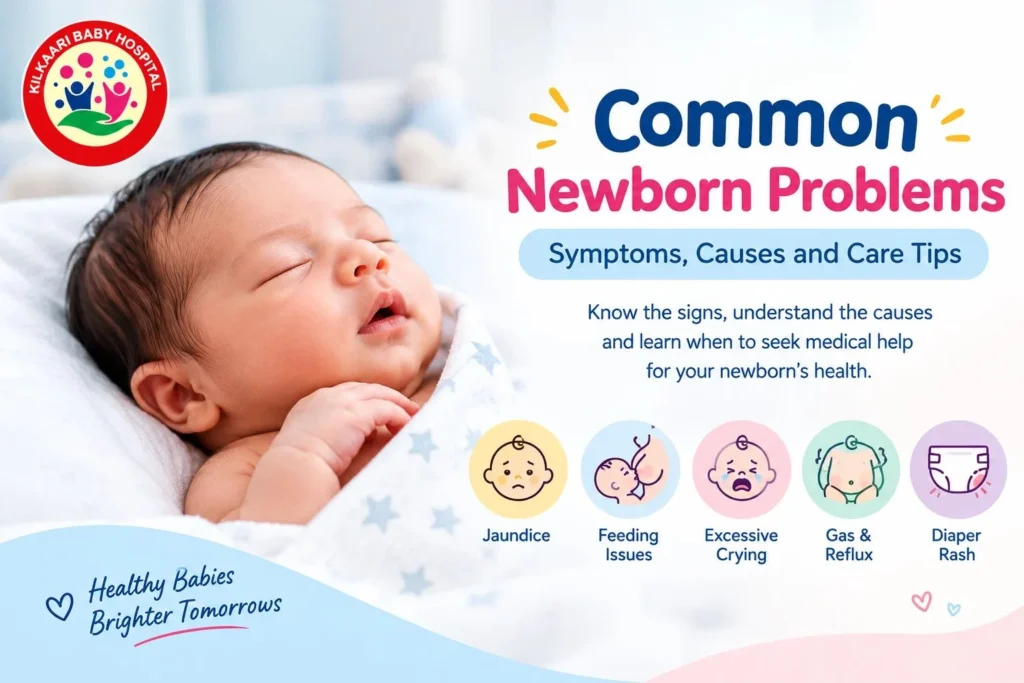
The first few weeks after birth are an exciting but sometimes challenging time for new parents. Newborn babies are adjusting to life outside the womb, and parents may notice changes in feeding, sleeping, digestion, skin colour and crying patterns. Many common newborn problems are temporary and can be managed with appropriate care and guidance. However, some symptoms may indicate an illness that needs prompt medical attention. Understanding the difference can help parents make informed decisions about their baby’s health.
In this guide, we explain common problems in newborn babies, their possible causes, practical care tips and warning signs that parents should never ignore.
What Are the Most Common Newborn Problems?
Newborns can experience a variety of health and care-related concerns during the first few weeks of life. These may include feeding difficulties, newborn jaundice, colic, reflux, diaper rash and changes in bowel movements.
Some common newborn problems are part of normal development, while others require assessment by a paediatrician.
1. Newborn Jaundice
Newborn jaundice is a common condition that causes a baby’s skin and the whites of their eyes to appear yellow. It occurs when bilirubin, a yellow substance produced as red blood cells break down, builds up in the blood.
A newborn’s liver may need time to process bilirubin efficiently.
Common signs of newborn jaundice include:
- Yellowing of the skin or whites of the eyes.
- Yellow colour spreading from the face to other parts of the body.
- Poor feeding or unusual sleepiness in more serious cases.
A healthcare professional may check the baby’s bilirubin level and recommend monitoring or treatment, such as phototherapy, when necessary.
Parents should not rely on sunlight or home remedies to treat jaundice. Seek prompt medical assessment if you notice yellowing, especially during the first 24 hours after birth.
2. Feeding Difficulties
Some newborn babies have difficulty latching, sucking effectively or feeding regularly. Parents may also worry about whether their baby is getting enough breast milk or formula.
Possible signs of newborn feeding problems include:
- Difficulty latching onto the breast.
- Weak sucking or repeatedly falling asleep during feeds.
- Feeding much less than usual.
- Fewer wet nappies than expected.
- Poor weight gain.
To support newborn feeding, hold your baby comfortably, look for early hunger cues and ask a healthcare professional or lactation specialist for help if breastfeeding is painful or difficult.
A newborn who refuses feeds, cannot suck effectively or becomes unusually sleepy needs urgent medical assessment. Do not force-feed a baby who is struggling to breathe or remain alert.
3. Excessive Crying and Colic
Crying is one of the main ways newborns communicate hunger, discomfort, tiredness and the need for comfort. Some babies cry for longer periods without an obvious reason. This may sometimes be described as colic.
Possible signs include:
- Repeated periods of intense crying.
- Difficulty settling despite feeding and comforting.
- Clenching fists or drawing the legs towards the tummy.
Parents can try checking whether the baby is hungry, needs a nappy change, feels too hot or cold, or needs gentle soothing. Holding the baby, speaking softly and gently rocking them may help.
Never shake a baby. If crying is unusual, persistent or accompanied by fever, vomiting, poor feeding, breathing problems or unusual drowsiness, seek medical advice rather than assuming it is colic.
4. Spitting Up and Reflux
Many newborns bring up small amounts of milk after feeding. This is often called spitting up and may happen because the muscle between the food pipe and stomach is still developing.
Reflux may cause milk to come back into the mouth, sometimes with burping.
Helpful feeding practices may include:
- Feeding your baby in a comfortable position.
- Burping the baby gently during or after feeds.
- Holding the baby upright while they are awake after feeding.
- Avoiding pressure on the baby’s tummy.
Always place your baby on their back on a firm, flat sleep surface, even if they have reflux. Do not use inclined sleepers or raise the mattress unless specifically instructed by a qualified healthcare professional.
Seek urgent medical care if your baby has green or bloody vomit, repeated forceful vomiting, a swollen tummy, breathing difficulty or poor feeding.
5. Gas and Tummy Discomfort
Newborn babies may appear uncomfortable, pull their legs towards their tummy or become unsettled after feeding. Swallowed air during feeding can contribute to gas.
Parents may find it helpful to:
- Burp the baby gently.
- Check that the feeding position is comfortable.
- Hold the baby upright while awake after feeding.
- Ask a healthcare professional to review feeding technique if discomfort continues.
Do not give gripe water, herbal preparations, medicines or other remedies without checking with your baby’s healthcare professional.
Persistent crying, a swollen abdomen, green vomit, blood in the stool or poor feeding should not be dismissed as ordinary gas.
6. Constipation and Changes in Bowel Movements
A newborn’s stool pattern can vary depending on age and whether the baby is breastfed or formula-fed. Stool frequency alone does not always indicate constipation. Possible signs of constipation include hard, dry stools and discomfort while passing stool. Straining or turning red while passing a soft stool may occur in young babies and does not necessarily mean constipation.
Parents should monitor stool consistency, feeding and wet nappies. Do not give water, laxatives or other treatments to a newborn unless advised by a qualified healthcare professional.
Contact a paediatrician if stools are persistently hard or the baby seems uncomfortable. Seek urgent assessment if constipation occurs with a swollen tummy, repeated vomiting, blood in the stool or poor feeding.
7. Diaper Rash
Diaper rash is irritation of the skin covered by a nappy. It can occur when the skin remains exposed to moisture, urine or stool for too long.
Common symptoms include:
- Red or irritated skin around the diaper area.
- Tenderness during nappy changes.
- Spots or patches of irritated skin.
To help prevent diaper rash:
- Change wet or soiled nappies promptly.
- Clean the area gently and pat it dry.
- Allow the skin to air-dry when practical.
- Use a suitable barrier cream if recommended by a healthcare professional.
Seek medical advice if the rash is severe, spreads, develops blisters or pus, or does not improve with basic care.
8. Cradle Cap and Dry Skin
Newborn skin can peel, become dry or develop cradle cap. Cradle cap usually appears as greasy, yellowish or flaky patches on the scalp. Gentle skin care is generally sufficient for mild dryness. Wash the scalp gently and avoid picking or scratching the flakes. Do not use medicated products without professional guidance.
Contact a healthcare professional if the skin becomes very red, swollen, painful, starts oozing or the rash spreads beyond the scalp.
9. Blocked Nose and Breathing Concerns
Newborn babies may occasionally make snuffling noises because their nasal passages are small. However, breathing difficulties can also be a sign of a serious medical problem.
Watch for:
- Rapid or laboured breathing.
- Grunting with each breath.
- The skin pulling in around the ribs or chest.
- Pauses in breathing.
- Blue or grey lips or tongue.
- Difficulty feeding because of breathing problems.
If any of these warning signs occur, seek emergency medical care immediately. Do not wait to see whether the symptoms disappear.
For mild nasal congestion, ask your healthcare professional about safe options. Avoid giving cold medicines or using unapproved remedies for a newborn.
10. Sleep Difficulties
Newborn babies sleep in short periods and wake frequently for feeding and comfort. Their sleep patterns may be irregular during the first few weeks.
Parents can support safe sleep by:
- Placing the baby on their back for every sleep.
- Using a firm, flat and uncluttered sleep surface.
- Keeping pillows, loose blankets, soft toys and other loose objects out of the baby’s sleeping area.
- Avoiding overheating.
- Keeping the baby’s sleep space separate from adult beds.
Frequent waking is common, but unusual difficulty waking a baby, weak responses or a sudden change in alertness can indicate illness and needs prompt assessment.
11. Newborn Fever or Low Body Temperature
Newborn babies may not show obvious signs of illness even when they are seriously unwell. A fever or unusually low body temperature can be an important warning sign.
For a baby younger than three months, a temperature of 38°C (100.4°F) or higher requires urgent medical assessment. A temperature below 36°C can also be concerning, particularly when the baby appears unwell.
Other warning signs may include:
- Poor feeding
- Unusual sleepiness or difficulty waking
- Weak or continuous crying
- Reduced movement
- Breathing difficulties
Do not give fever medicines to a newborn unless a healthcare professional specifically advises you. Seek urgent medical care if you suspect a fever or the baby feels unusually cold and appears unwell.
12. Umbilical Cord Problems
The umbilical cord stump usually dries and falls off on its own. Until then, keep the area clean and dry and follow your healthcare professional’s cord-care advice.
Contact a healthcare professional if you notice:
- Redness spreading around the belly button.
- Pus or foul-smelling discharge.
- Swelling or increasing tenderness.
- Continued bleeding.
If the baby has a fever, poor feeding, unusual sleepiness or looks generally unwell alongside signs of a cord infection, seek urgent medical care.
When Should Parents Seek Immediate Medical Help?
Newborns can become seriously ill quickly, and symptoms may be subtle. Do not wait for several symptoms to appear before seeking help.
Get urgent medical help if your newborn:
- Has difficulty breathing, pauses in breathing or blue/grey lips or tongue.
- Has a temperature of 38°C or higher.
- Is unusually cold or has a temperature below 36°C.
- Is difficult to wake, floppy or unresponsive.
- Refuses feeds or cannot feed effectively.
- Has a seizure
- Develops jaundice during the first 24 hours after birth.
- Has green or bloody vomit or appears seriously unwell.
If the baby is unresponsive, has severe breathing difficulty or is turning blue, contact local emergency services immediately.
How Can Parents Help Prevent Common Newborn Problems?
Not every newborn problem can be prevented, but careful daily care and timely medical checkups can help parents identify concerns early.
Useful practices include:
- Follow recommended checkups: Attend newborn follow-up appointments and discuss any concerns with a paediatrician.
- Support feeding: Seek help if the baby struggles to latch, feeds poorly or has fewer wet nappies than expected.
- Maintain hygiene: Wash hands before handling the baby and follow appropriate cord and diaper care.
- Follow safe sleep practices: Place the baby on their back on a firm, flat sleep surface.
- Monitor changes: Notice changes in feeding, breathing, skin colour, temperature, activity and urine output.
- Follow vaccination advice: Keep your baby’s immunisations up to date according to the current recommended schedule.
Avoid self-medication: Do not give medicines, herbal remedies or supplements without appropriate medical advice.
Conclusion
Understanding common newborn problems can help parents feel more prepared during the first weeks of their baby’s life. Feeding difficulties, jaundice, gas, reflux, diaper rash and sleep changes are among the concerns parents may encounter, but not every symptom is harmless.
Observe your baby closely, follow safe newborn-care practices and consult a qualified paediatrician whenever you are concerned. Early medical assessment is especially important when a newborn has fever, breathing difficulty, poor feeding or unusual drowsiness.
Frequently Asked Questions
1. What are the most common problems in newborn babies?
Common concerns include feeding difficulties, jaundice, spitting up, gas, excessive crying, diaper rash, dry skin and changes in bowel movements. Some are mild, but symptoms such as fever, breathing difficulty or poor feeding need prompt medical assessment.
2. Is jaundice normal in newborn babies?
Jaundice is common, but it should not be ignored. A healthcare professional may need to measure the baby’s bilirubin level and decide whether monitoring or treatment is required. Jaundice appearing in the first 24 hours needs urgent assessment.
3. How do I know if my newborn is seriously ill?
Warning signs include difficulty breathing, a temperature of 38°C or higher, unusually low temperature, poor feeding, difficulty waking, blue or grey lips, seizures or rapidly worsening jaundice. Seek urgent medical help if any of these occur.
4. Why does my newborn cry so much?
Babies may cry because they are hungry, tired, uncomfortable or need soothing. Persistent or unusual crying, especially with vomiting, fever, poor feeding or drowsiness, should be assessed by a healthcare professional.
5. When should I take my newborn to a paediatrician?
Arrange routine newborn checkups as recommended by your healthcare professional. Seek urgent care for warning signs such as fever, breathing difficulty, poor feeding, unusual sleepiness or worsening jaundice. Do not wait for a routine appointment if your baby appears seriously unwell.
Pingback: Newborn Care After Birth: A Complete Guide for Parents