A newborn’s health needs special attention, especially during the first few weeks after birth. If your baby feels unusually warm, is feeding less than usual or seems sleepier than normal, you may wonder whether your newborn has a fever. Fever in a newborn can be a sign of a serious infection and requires urgent medical assessment.
A temperature of 38°C (100.4°F) or higher in a baby younger than three months needs immediate medical attention, even if the baby otherwise appears well. Do not wait for other symptoms to develop. In this guide, we explain the signs of fever in newborn, possible causes, how to check your baby’s temperature and when to seek medical help.
What Is Considered a Fever in Newborn?
A fever is an increase in body temperature that can occur when the body responds to an infection or another medical condition.
For a baby younger than three months, a temperature of 38°C (100.4°F) or higher is a medical concern that requires urgent assessment. A newborn may have a serious infection without showing obvious symptoms, so parents should not rely only on how the baby looks or feels.
If you suspect your newborn has a fever, contact a healthcare professional immediately or take your baby to the nearest hospital emergency department. Do not delay medical care to repeat measurements or try home remedies.
Common Symptoms of Fever in Newborn
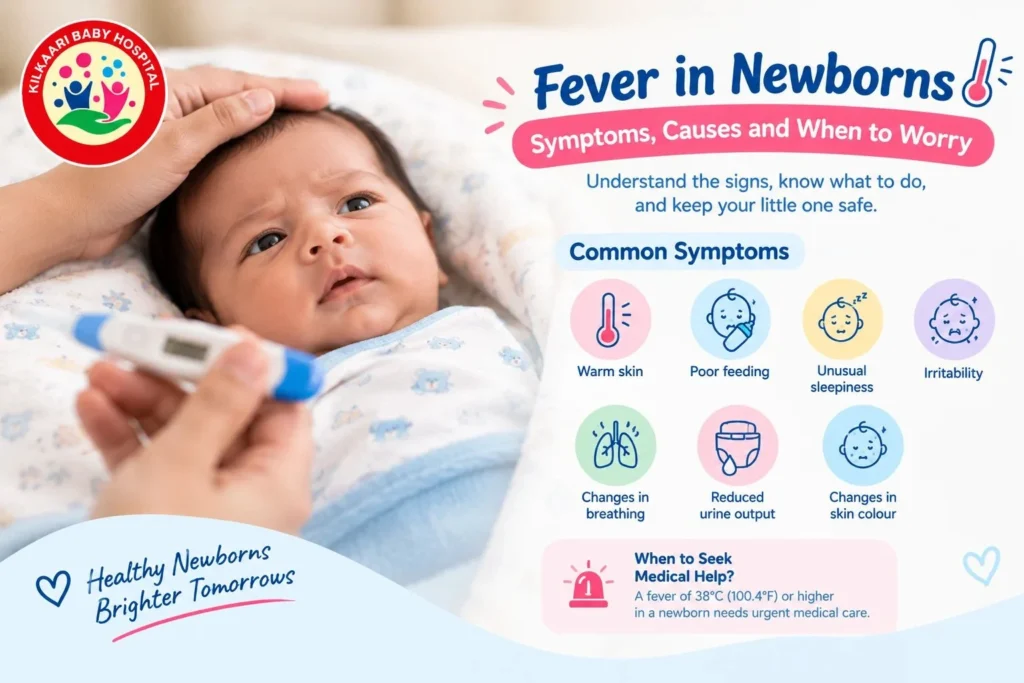
A newborn with a fever may show one or more of the following signs:
- Warm skin: Your baby’s body may feel warmer than usual.
- Poor feeding: The baby may refuse feeds or feed less than usual.
- Unusual sleepiness: Your baby may be less active or difficult to wake.
- Irritability: The baby may cry more than usual or be difficult to settle.
- Changes in breathing: Breathing may become faster or more difficult.
- Reduced urine output: Wet nappies may become less frequent.
- Changes in skin colour: The skin may appear unusually pale, grey, mottled or blue.
Not every newborn with an infection develops a high temperature. Some babies may have a temperature that is lower than normal or may simply appear unwell.
Seek emergency medical help immediately if your baby is difficult to wake, has trouble breathing, develops blue or grey lips or skin, has a seizure or develops a rash that does not fade when pressed.
What Causes Fever in Newborn?
Several conditions can cause a newborn’s temperature to rise. The cause cannot be determined reliably from temperature alone, and a doctor may need to examine the baby and perform tests.
1. Viral Infections
Viruses can cause infections that lead to fever. Some may also cause a runny nose, cough, feeding difficulties or changes in activity.
2. Bacterial Infections
Bacterial infections are an important concern in newborns. Possible causes include urinary tract infections, pneumonia and bloodstream infections.
3. Serious Infections
Conditions such as sepsis and meningitis can cause fever or other temperature abnormalities in newborns. These illnesses can progress quickly and need urgent medical assessment.
4. Fever After Vaccination
Some babies develop a temperature after receiving vaccinations. However, a fever in a baby younger than three months should not automatically be assumed to be a normal vaccine reaction. Contact a healthcare professional promptly and follow their advice.
5. Overheating
Too many layers of clothing, heavy blankets or a very warm environment can make a baby feel hot. However, overheating should not be assumed to be the cause of a measured fever. A temperature of 38°C or higher in a newborn still requires urgent medical assessment.
How to Check a Newborn’s Temperature
If your newborn feels warm or appears unwell, use a suitable digital thermometer rather than relying on touch alone.
Follow these steps:
- Choose a digital thermometer suitable for your baby’s age.
- Follow the manufacturer’s instructions for the recommended measurement site.
- Record the temperature and the time it was taken.
- Tell the healthcare professional the reading and how you measured it.
- Seek urgent medical care if your baby is younger than three months and has a temperature of 38°C or higher.
The NHS recommends measuring a young child’s temperature with a digital thermometer in the armpit. Some other clinical guidelines use different measurement methods, so follow professional advice on the most appropriate method for your newborn. Do not use an ear thermometer for a very young baby unless specifically advised by a healthcare professional.
What Should Parents Do If a Newborn Has a Fever?
If your newborn has a fever, take the following steps while arranging medical care.
- Seek urgent medical assessment: Do not wait to see whether the fever goes away.
- Continue offering feeds if your baby is awake and able to feed: Breast milk or the baby’s usual prescribed feeding plan can help maintain intake. Do not force-feed a baby who is struggling to feed.
- Dress your baby comfortably: Avoid excessive layers and heavy blankets, but do not deliberately make the baby cold.
- Monitor your baby’s condition: Note feeding, wet nappies, breathing, alertness and temperature.
- Avoid self-medication: Do not give paracetamol, ibuprofen, antibiotics or other medicines to a newborn unless a healthcare professional specifically directs you to do so. Never give aspirin to a child.
Do not use cold baths, ice, alcohol rubs or home remedies to bring down a newborn’s temperature. These measures do not treat the underlying cause and may be harmful.
When Should You Take a Newborn to the Hospital?
A newborn needs immediate medical assessment if:
- If the baby is younger than three months and has a temperature of 38°C (100.4°F) or higher.
- The baby has a temperature below 36°C and appears unwell.
- The baby refuses feeds or has significantly fewer wet nappies.
- The baby is unusually sleepy, floppy or difficult to wake.
- The baby has fast or laboured breathing.
- The baby develops blue, grey, pale or mottled skin.
- The baby has a seizure or a rash that does not fade when pressed.
If your baby has severe breathing difficulty, is unresponsive or has blue lips, call your local emergency service immediately.
How Can Parents Help Prevent Infections in Newborns?
Not all infections can be prevented, but parents can take practical steps to reduce exposure to germs.
- Wash your hands before touching or feeding your baby.
- Ask visitors to postpone visits if they are sick.
- Keep your newborn away from people with contagious illnesses where possible.
- Follow your healthcare professional’s advice on newborn vaccinations and routine checkups.
- Keep feeding equipment clean and prepare feeds safely.
- Avoid exposing your baby to cigarette smoke and vaping aerosols.
For further guidance, read our article on newborn care after birth.
Conclusion
Fever in a newborn should always be taken seriously, especially during the first three months of life. A temperature of 38°C (100.4°F) or higher requires urgent medical assessment, even if your baby seems comfortable.
Parents should know the warning signs, use a suitable thermometer and avoid delaying care while trying home remedies. Prompt medical assessment helps healthcare professionals identify the cause and provide appropriate treatment.
Frequently Asked Questions
- What temperature is a fever in a newborn?
A temperature of 38°C (100.4°F) or higher in a baby younger than three months is considered a fever that needs urgent medical assessment.
2. Can a newborn have a fever without other symptoms?
Yes. A newborn may have a serious infection even when fever is the only noticeable symptom. Seek urgent medical assessment rather than waiting for additional signs.
3. Can teething cause fever in a newborn?
Teething is not a safe explanation for fever in a newborn. If a baby younger than three months has a temperature of 38°C or higher, urgent medical assessment is needed.
4. Should I give medicine to reduce my newborn’s fever?
Do not give fever-reducing medicine to a newborn without specific instructions from a healthcare professional. Fever may indicate an infection that needs prompt investigation and treatment.
5. Can a newborn have an infection without a fever?
Yes. Some newborns with serious infections may have a normal or unusually low temperature instead of a fever. Poor feeding, difficulty breathing, unusual sleepiness or other signs of illness also require prompt medical attention.